

Section 1 vs Section 2 Termite Reports: Who Pays When You Sell in Berkeley or Oakland (2026)
Who pays for Section 1 termite work when you sell a home in Berkeley or Oakland?
In the East Bay, the seller almost always pays for Section 1 termite work—active infestation and current damage that the buyer's lender needs cleared before funding. The buyer typically absorbs Section 2 items, which are conditions that could lead to future damage but aren't active problems. That split is Bay Area custom, not California law, and it holds in the vast majority of Berkeley, Oakland, Albany, El Cerrito, and Piedmont escrows in 2026. On an average single-family home, the seller-paid portion runs anywhere from a few hundred dollars for spot treatment to $7,000+ if the house needs to be tented.
If you're preparing to list a home in the East Bay, the pest report is one of the two or three line items most likely to catch you off guard. You budgeted for commission. You know about title fees and transfer tax. But nobody warned you that the WDO report — the wood-destroying organism report a licensed inspector produces after crawling your foundation and poking at your eaves—can add anywhere from $500 to well over $10,000 to your closing costs.
Here's what actually happens, block by block, in an East Bay transaction.
Section 1 vs. Section 2: What the report is actually saying
The California Structural Pest Control Board requires every WDO inspection to sort findings into two categories.
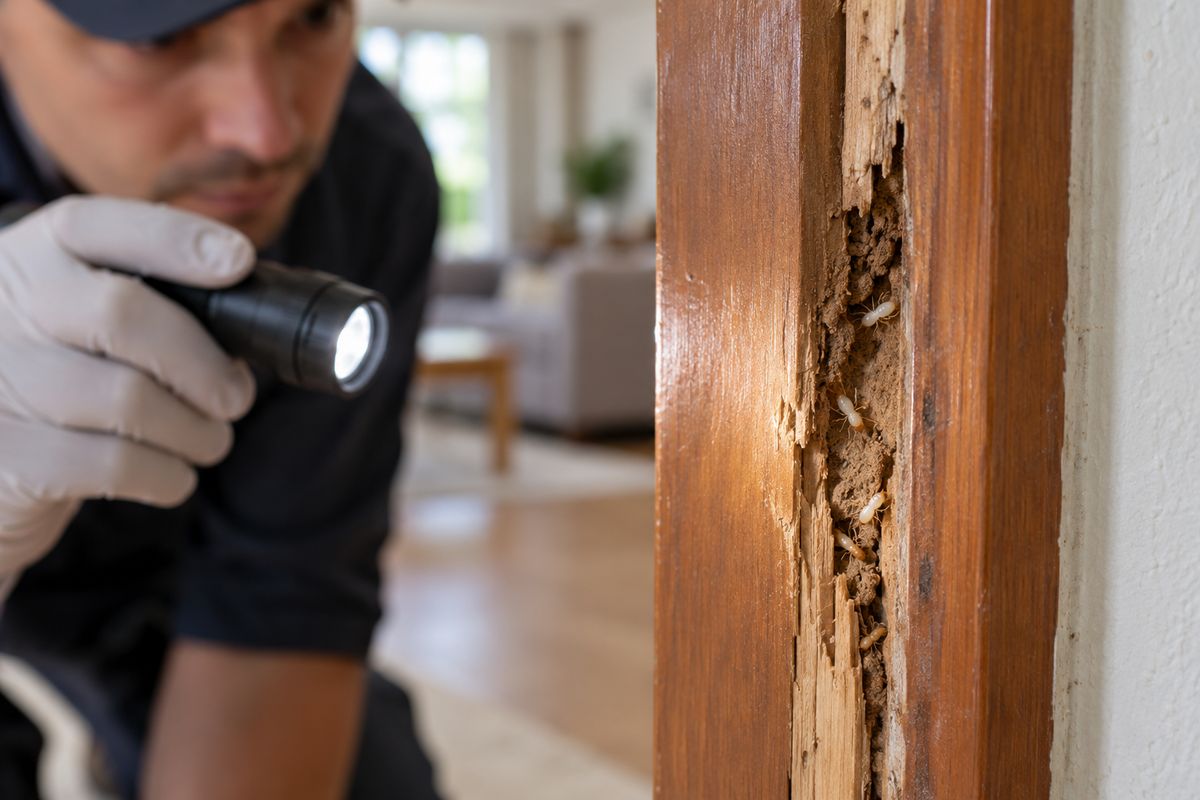
Section 1 covers active infestations and current damage. That's live subterranean termites in your mud sills, drywood termites in a porch beam, dry rot at the base of a bathroom wall, fungal decay in the crawl space—anything the inspector can see is either eating your house right now or has already eaten a part of it. Section 1 items need to be corrected or the lender won't fund the loan.
Section 2 covers conditions likely to lead to infestation. Wood-to-soil contact on a fence attached to the house. A cracked vent screen an insect could crawl through. Excessive moisture at a foundation vent. A wood scrap left in the crawl space by a contractor. These items don't require immediate repair, and lenders generally don't hold up funding over them.
The distinction matters because it drives the whole negotiation. Section 1 is money the seller expects to spend to close the deal. Section 2 is money the buyer takes on as part of ongoing homeownership—or negotiates as a credit.
Why "the seller pays Section 1" is Bay Area custom
Nothing in the California Civil Code assigns Section 1 costs to the seller. In theory, you could list your home explicitly as-is, refuse to touch the pest report, and let the buyer decide whether to pay for treatment themselves. In practice, that rarely works in the East Bay for two reasons.
First, the loan. FHA and VA loans require Section 1 clearance to fund. Most conventional lenders in a tight underwriting environment do too. If your buyer is financing (and in the $1M–$5M East Bay market, more than 80% are), the pest report isn't optional.
Second, the market. Buyers in Berkeley and Oakland who write $1.5M–$3M offers on 1920s Craftsmans are financially sophisticated. They already assume the seller will handle Section 1. When a listing goes on-market "as-is, buyer takes pest," the market prices in the concession—the offers come in lower by roughly the estimated Section 1 total, and sometimes more, because buyers hate uncertainty on a bill they can't yet quantify. You don't save money by shifting the report to the buyer; you just complicate the negotiation.
The one place I regularly see the custom break is on trust sales, probate sales, and out-of-state seller listings where the seller genuinely can't or won't pay. Those go on-market as-is, and the market adjusts.
What Section 1 actually costs on an East Bay home
Costs vary widely because the report can range from "one damaged porch beam" to "the house needs to be tented and half the sub-area rebuilt." But here's a rough map for a mid-size Berkeley or Oakland single-family home in 2026:
- Localized subterranean treatment (drilling and injecting termiticide at the slab perimeter or foundation): commonly $1,500–$3,500 depending on square footage and access.
- Localized drywood spot treatment (drilling and injecting into the affected beam, or heat treatment): $300–$1,200 per area.
- Whole-house tenting/fumigation with Vikane: Bay Area pricing runs roughly 10–15% higher than the national midpoint because dense-lot tarp logistics, street closures, and parking permits add cost. Expect $2,500–$3,500 on the low end for a smaller home, and detailed bids at $3.50 per square foot of tarp footprint—a 2,100 sq ft tarp adds up to about $7,350 on a mid-size Elmwood or Rockridge bungalow.
- Dry rot repair (replacing damaged siding, trim, subfloor, sill plate): $800–$8,000+ depending on scope. Extensive sill plate replacement on an older Berkeley home can spike this number quickly.
- Section 2 items (if you elect to handle them): usually $200–$1,500 total, most often bundled into a broader punch list.
For an older single-family home in North Berkeley, Elmwood, Claremont, Rockridge, Temescal, or Piedmont Avenue—homes routinely built between 1905 and 1940 with wood shingle exteriors and unreinforced sub-areas—I tell sellers to budget $3,500–$8,000 for Section 1, with a real chance it runs higher if the crawl space reveals rot at the mud sills.
Homes in Kensington, the Berkeley Hills, and the Oakland Hills add moisture risk from the fog belt, which tends to push dry rot findings higher even when live termites are absent.
When you should pay for the pest report
Most East Bay listings I take on order the pest inspection before we go on market, along with the general home inspection, sewer lateral, natural hazard disclosure, and (in Berkeley) the BESO energy assessment. Ordering early gives you three things:
- You know the Section 1 number before you price. If the house needs a $7,000 tenting, we can either build that into the list price, get the work done ahead of listing, or offer a credit at close — but we're doing it deliberately, not reacting to a buyer's surprise.
- You can negotiate the vendor. Termite companies quote higher for time-pressured escrow work than for a scheduled pre-listing job. Getting three bids before the property goes live typically saves 10–20% on treatment costs.
- You control disclosure. The pest report goes into the pre-listing disclosure package alongside the pre-listing inspection materials buyers use to write non-contingent offers.
Every situation is different, and the only way to know for sure is to run the numbers with someone who knows this market block by block. That's exactly the kind of question I walk my clients through before we even talk about listing.
What if the buyer wants Section 2 handled too?
In a competitive multiple-offer environment on a well-prepared Berkeley or Oakland listing, buyers rarely push hard on Section 2. In a slower micro-market—or on a home with a smaller buyer pool—buyers do sometimes ask for Section 2 items to be corrected or credited.
The negotiation usually settles one of three ways:
- Split by category. Seller handles subterranean and dry rot; buyer takes fence-to-soil contact and vent screens.
- Cash credit at close. Seller credits the buyer $500–$2,000 toward Section 2, buyer handles the work post-close.
- Section 2 waived. Buyer accepts the report as-is because they're bidding aggressively and don't want the seller taking on a repair scope they'll fold into the transaction.
The right answer depends on the strength of the offer, the seller's timeline, and how much of the pest scope overlaps with the rest of the punch list. This overlaps with the same "what surprises East Bay sellers late in escrow" territory that comes up around EBMUD sewer lateral compliance and other point-of-sale items.
What almost never works
A few approaches I see out-of-market sellers try that generally backfire in the East Bay:
- Refusing to allow a pest inspection. In a market where buyers write non-contingent offers based on the seller's disclosure package, no inspection means no offer—or offers well below the list.
- Only providing an inspection with no clearance. If a buyer sees a Section 1 finding with no bid attached, they'll assume the worst-case number and price their offer accordingly.
- Using the cheapest pest company you can find on Yelp. The lowest bidder often writes the largest Section 1 finding because they know they'll be the one contracted to do the work. Ordering a report from a company that competes on inspection quality—not on treatment volume—gives you a more accurate picture.
What to ask your listing agent before you order the report
Three questions worth asking before you sign the pest company's inspection agreement:
- Do you have three bids I can compare? A good listing agent has a short list of East Bay pest companies with a track record of accurate, defensible reports and reasonable treatment pricing.
- Which items do we handle before listing, and which do we quote and credit? Some Section 1 items (tenting, sub-area rebuilds) are easier for the buyer to project-manage post-close with a credit. Others (a live subterranean colony in the mud sills) genuinely have to be corrected before close.
- How does this interact with the other point-of-sale requirements? In Berkeley, BESO, RECO, and the sewer lateral inspection all touch the same crawl space and roof access the pest inspector uses. Sequencing matters—and so does how the punch list ends up presented to the buyer.
FAQ
Is a termite inspection required by California law to sell a home?
No. California does not require sellers to obtain a termite inspection to sell a home. But most buyers—and virtually all lenders on financed purchases—will require one before closing. In practice, every East Bay listing above the $1M price point goes to market with a WDO report in the disclosure package.
Who orders the termite inspection—the buyer or the seller?
Either can. In the East Bay, listing agents typically order it as part of the pre-listing inspection package so the report is available to buyers before they write offers. If the buyer orders it post-acceptance, it usually happens in the first 5–7 days of escrow.
Do Section 1 clearances expire?
Yes. Most California pest clearance certificates are valid for two years from the date of the original report. If a home has been off-market for more than two years since the last clearance, a new inspection is typically required.
Can I sell my Berkeley or Oakland home as-is and skip the pest work?
You can. You'll receive fewer offers, and the offers you receive will typically be lower than what a fully-cleared property would fetch — usually by more than the cost of the Section 1 work itself. As-is sales make sense for trust sales, probate sales, and estate liquidations where the seller genuinely can't fund treatment; they rarely make sense for owner-occupied East Bay listings.
Do I have to disclose a previous Section 1 report even if the work was done?
Yes. Prior pest reports and completed work are material facts that go on the Transfer Disclosure Statement (TDS) and the Seller Property Questionnaire (SPQ). Buyers generally view completed treatment as a positive — it means the risk was addressed — not a negative.
The bottom line
If you're listing a home in Berkeley, Oakland, Albany, El Cerrito, Kensington, Piedmont, or Emeryville in the next six months, budget $3,500–$8,000 for Section 1 termite work on a typical pre-1940 single-family home, plan on ordering the WDO report before you go on-market, and expect the buyer to accept Section 2 items in a competitive offer environment.
The way to shrink the surprise is to get the report early, get three bids, and price the work into your list price and net sheet — not into your last-minute stress at week three of escrow.
Want to know your specific number? I prepare a custom net sheet for every seller I work with — actual estimated proceeds based on East Bay market data, your home's condition, and current closing costs including realistic pest, sewer lateral, and BESO/RECO estimates. No automated estimate, no generic Zestimate. Just real numbers.
About the Author
Robert Parker is the CEO and team lead of The Parker George Team at Compass, serving the East Bay luxury residential market in Berkeley, Oakland, Piedmont, and surrounding neighborhoods. He helps buyers and sellers navigate the $1M–$5M+ market with a data-driven approach grounded in over a decade of local experience. DRE# 01923837. Connect with Robert at parkergeorge.com.
Check out this article next