

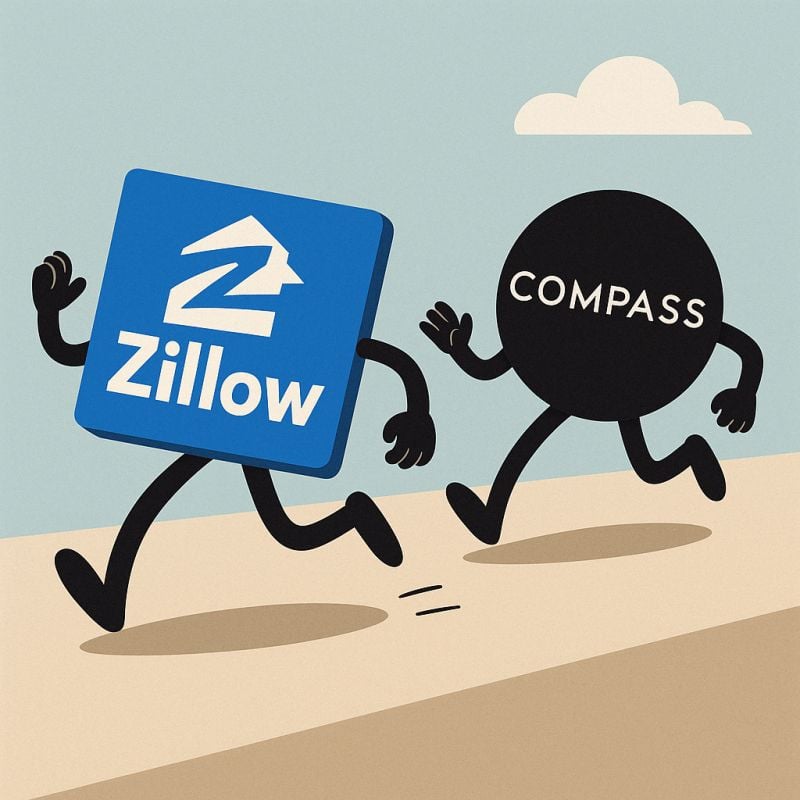
Compass Private Exclusive vs. Going Straight to MLS in 2026: The Three-Phase Decision Every East Bay Luxury Seller Has to Make at the Listing Table
THE QUESTION SELLERS ARE ACTUALLY ASKING
If you are sitting down to list a Berkeley, Oakland, Piedmont, or Kensington home above $1.5M in 2026, you will be shown a three-phase marketing chart. Phase 1 is Compass Private Exclusive — a private, in-network soft launch to roughly 34,000 Compass agents and their qualified buyers. Phase 2 is Compass Coming Soon — pre-MLS exposure on Compass.com and now Redfin. Phase 3 is Active on MLS, with full public syndication to Zillow, Realtor.com, and the Bay East MLS your eventual buyer is searching.
The pitch sounds clean. Test pricing privately. No public days on market. No price-drop history. Soft launch first; full launch later.
The question you will be asked to answer — usually in the same meeting, often before you have had a chance to read the new Compass seller disclosure form carefully — is whether to start in Phase 1, Phase 2, or skip to Phase 3.
I am a Compass agent. The Parker George Team lists under the Compass banner in Berkeley, Oakland, and the surrounding East Bay luxury corridor. I have a structural interest in the answer being "yes, do the private phase," because there is a path in which the brokerage and the listing agent benefit from finding a buyer in-network before the home ever sees the MLS. I want to be straight with you about that, because the only way this decision is honest is if it accounts for that conflict — and for the actual data on both sides.
This post walks through the three-phase strategy as it stands in June 2026, the live industry dispute behind it, the math on premium vs. discount, the trade-offs at the East Bay luxury price points where we work, and a five-question decision framework I use with the sellers I represent. By the end, you should know exactly which phase to start in — and exactly why.
WHAT THIS POST ANSWERS
Should I start my East Bay luxury home sale as a Compass Private Exclusive, a Compass Coming Soon, or go straight to MLS? For most Berkeley and Oakland sellers in the $1.5M–$5M range in 2026, the right starting point is Compass Coming Soon for 7 to 14 days, then a full MLS launch. Private Exclusive only beats Coming Soon when at least one of the following is true: the home is hard to access in showing condition; the seller has a strict privacy constraint (tenant in place, divorce, public-figure exposure); the property is genuinely irreplaceable and the buyer pool is fewer than 50 nationwide; or the seller wants to test a price ceiling without recording a price-drop comp. In a cooled-but-tight 2026 East Bay luxury market — Berkeley homes still drawing five offers and selling in roughly 15 days median — keeping the home in Phase 1 for more than 14 days usually costs the seller real exposure dollars, regardless of which study you cite. Sign the Compass seller disclosure with eyes open, set explicit phase exit triggers in writing, and never let "private" become "permanent."
THE INDUSTRY FIGHT IN ONE PARAGRAPH
NAR's Clear Cooperation Policy required member-MLS listings to be entered within one business day of any public marketing. NAR amended that policy in March 2025 to allow a "delayed marketing period" — the legal carve-out that makes the Compass three-phase strategy work today. Zillow then created its own rule penalizing Private Exclusive homes if they sit pre-MLS for more than one business day. Compass sued Zillow over it; in March 2026, Compass dropped that suit. Separately, Compass is in active litigation against the Northwest MLS over similar restrictions, with trial moved to October 2026. New York's Fair and Transparent Real Estate Listings Act advanced June 12, 2026 — requiring private-listing disclosure forms by law. None of this is settled. All of it shapes what you are actually being asked to sign.
This matters because if you sign a Compass listing agreement that elects Phase 1, you are doing two things at once: choosing a marketing strategy AND opting into a controversial industry posture. You should know that before you sign.
THE THREE-PHASE STRATEGY, PLAINLY
Phase 1 — Compass Private Exclusive
Your home is marketed only to Compass agents on the internal network. No public website. No Zillow. No Bay East MLS. No days on market are accumulating. No price-drop history is recordable. You can change the price three times in a week and the public will never see a single change.
The Compass argument: 34,000 agents is a real audience. Many of the best East Bay luxury buyers are working with Compass agents because Compass owns roughly the dominant share of luxury market activity in Berkeley and Oakland. So a Private Exclusive reaches the highest-converting fraction of the buyer pool without the costs of public exposure.
The opposing argument, articulated by Jonathan Miller and the Consumer Federation of America and echoed by Zillow's economist Orphe Divounguy in a May 2026 Inman piece, is simpler: scarcity creates uncertainty pricing. When buyers don't know how many other buyers have seen the home, they price in risk. Across a national data set, off-MLS sales come in roughly $5,000 lower per home — about a 1.5% discount — and the loss widens to 3.2% (about $9,850) in communities of color.
So which is it? Compass's own data says pre-marketing sells for 2.9% more than going straight to MLS (95% confidence interval 1.9%–3.9%). Independent academic research published in 2026 finds a 1.7% premium for off-MLS sales generally, and 8%+ for luxury. Zillow finds a 1.5% discount.
These results conflict because they are measuring different things on different samples. The Compass number compares pre-marketed listings to direct-to-MLS listings within Compass's own brokerage — a sample that is already skewed toward higher-condition, better-prepped homes that Compass agents have time to plan. The Zillow number takes a broader national pool, much of which is not luxury, much of which had no real reason to skip MLS in the first place. The independent luxury 8%+ number is the most directly applicable to an East Bay $2M–$4M sale, but the sample sizes are smaller and the homes selected for off-MLS sale tend to be unique in a way that confounds the comparison.
The honest read: at the very top of the luxury market — irreplaceable architecture, no real comp pool, fewer than 50 potential buyers globally — a private launch probably does help. At the more typical Berkeley/Oakland $1.5M–$3M Craftsman, mid-century ranch, or contemporary in Rockridge or North Berkeley, where there are 30 to 80 closely-comparable sales each year, the open-market pressure of MLS is what creates the premium. The cooled-2026 market is sharpening that distinction.
Phase 2 — Compass Coming Soon
Your home appears on Compass.com and (via the Compass-Rocket partnership announced in 2025) on Redfin.com as a Coming Soon listing. It is NOT on the Bay East MLS, not on Zillow's main feed, not on Realtor.com. No days on market accumulating. No price-drop history.
This is the phase Compass leans on most heavily when arguing that the three-phase strategy is in the seller's interest, because Phase 2 captures most of the supposed benefits of pre-marketing (no DOM clock, no price-drop record, agent-to-agent priming) while exposing the home to a much larger audience than Phase 1's 34,000 Compass agents. Redfin alone serves 60M+ unique monthly buyers.
For 70%+ of the East Bay luxury sellers I work with, Phase 2 for 7 to 14 days followed by Phase 3 is the right answer. It creates the priming and anticipation Compass's data captures, without the exposure penalty Zillow's data captures.
Phase 3 — Active on MLS
The home is fully syndicated. Bay East MLS. Zillow. Redfin. Realtor.com. Compass.com. Tour scheduling, open houses, offer dates, and the full marketing apparatus. Days on market start accumulating. Price changes are recorded publicly.
This is where, in 2026, your buyer most likely is — and where the actual price discovery happens. Of the offers I have written and received in the Berkeley/Oakland luxury segment in the past 24 months, the highest offer rarely came from the first 34,000 Compass agents. It came from the buyer who saw the home on Zillow at 11pm on a Tuesday, scheduled with their buyer's agent on Wednesday, walked through on Thursday, and wrote on Friday.
THE MATH AT YOUR PRICE POINT
Let me put numbers on the trade-off at three representative East Bay luxury price points, using the cooled-but-tight June 2026 market context. Your specific number depends on your home's condition, your neighborhood's micro-market, and your timing — that is where a real net sheet comes in — but the directional math holds.
$1.95M North Berkeley Craftsman, well-prepped, in good condition
- Probable comp pool: 40–60 closely-comparable Berkeley sales over the trailing 12 months.
- Likely buyer pool: 200+ qualified buyers actively searching this price band within 30 miles.
- Compass Private Exclusive (Phase 1 for 21 days): Probable list-to-sale ratio 99%–102%, two to three offers, ~30 days to contract from listing. Estimated final: $1.95M–$1.99M.
- Compass Coming Soon (Phase 2 for 10 days) → MLS: Probable list-to-sale ratio 103%–108%, four to seven offers, ~15 days to contract. Estimated final: $2.01M–$2.10M.
- Direct to MLS, no pre-marketing: Probable list-to-sale ratio 102%–106%, three to six offers. Estimated final: $1.99M–$2.07M.
Conclusion: Phase 2 wins by roughly $40K–$110K over Phase 1, and by $20K–$30K over direct MLS, in this scenario.
$2.85M Rockridge contemporary, irreplaceable architecture, narrow buyer pool
- Probable comp pool: 8–15 closely-comparable sales annually.
- Likely buyer pool: 50–80 truly qualified buyers nationally.
- Compass Private Exclusive (Phase 1 for 21 days): Could match a uniquely motivated Compass-represented buyer who pays the architecture premium. Estimated final: $2.95M–$3.10M.
- Compass Coming Soon (Phase 2 for 14 days) → MLS: Captures most architecture-buyer attention without exposure penalty. Estimated final: $2.95M–$3.05M.
- Direct to MLS: Risks the architecture-buyer feeling they're competing against generic comparison shoppers, which sometimes suppresses the premium. Estimated final: $2.85M–$2.95M.
Conclusion: Phase 1 is genuinely competitive here. Phase 2 is still safer for most sellers. Phase 3 alone underperforms.
$4.4M Berkeley Hills modern, $2M+ DOM-sensitive luxury
- Probable comp pool: 4–7 sales annually.
- Likely buyer pool: 30–50 qualified buyers, many of whom work with high-touch agents.
- The 2026 luxury DOM dynamic: $2M+ homes are sitting longer (March 2026 Berkeley data showed 17.4% of listings with at least one price reduction). DOM stigma matters more than at the $1.5M tier.
- Compass Private Exclusive (Phase 1 for 21 days): Lets you reset privately if the first price didn't pull. Estimated final: $4.35M–$4.50M.
- Compass Coming Soon (Phase 2 for 14 days) → MLS: Maximum exposure with DOM protection at launch. Estimated final: $4.40M–$4.60M.
- Direct to MLS: If the price is right, fine. If you have to adjust mid-listing, the public record costs you. Estimated final: $4.30M–$4.55M.
Conclusion: This is the price point where Phase 1's "private price test" value is most defensible. You still probably want to be in Phase 2 within 21 days, and Phase 3 within 35.
THE FIVE-QUESTION FRAMEWORK I USE WITH SELLERS
Before I recommend a starting phase, I walk through these five questions in writing. If you do this on your own, do it on paper with your spouse or partner before the listing meeting. The answers should determine the phase — not the agent's preference, not the brokerage's marketing template, and not the chart on the slide deck.
- Is there a real privacy reason to suppress public marketing? Examples that say yes: a tenant in place who hasn't been told the home is being sold; an active divorce where one spouse occupies; a public-figure household; a security concern. If yes, Phase 1 has a legitimate basis. If no — if the only "privacy" reason is "we don't want neighbors to know" — that is not strong enough to justify the exposure cost.
- How wide is the buyer pool at your price and architecture? Fewer than 50 qualified buyers nationally for your specific home (think a $4M Berkeley Hills mid-century modern with a particular view) is a different math than 200+ qualified buyers (a $2M North Berkeley Craftsman). Narrow buyer pools tolerate Phase 1 longer; wide buyer pools do not.
- What is your maximum tolerable days-on-market exposure if Phase 1 doesn't pull? Phase 1 days don't count toward your public DOM. Phase 2 days don't count either. But Phase 3 days do. If you can't tolerate more than 14 days of public DOM before you'd feel pressure to adjust, Phase 2 + Phase 3 with a sharper initial list price (read more on "Why Your East Bay Home Isn't Selling — And How to Fix It" at https://parkergeorge.com/why-your-east-bay-home-isnt-selling-and-how-to-fix-it/) is better than starting in Phase 1 and burning through three weeks before you ever see real market signal.
- Are you comfortable signing the Compass enhanced seller disclosure form? Compass rolled out a new, mandatory disclosure form in 2025–2026 acknowledging the trade-offs of pre-marketing — including the risk of fewer offers, lower sale price, and the agent's structural interest in finding a buyer in-network. The form exists because NAR, New York, and several state regulators are requiring it. Read it before you sign. If anything in it surprises you when you read it on listing day, that is a sign you need more time, not less.
- What are your phase exit triggers in writing? This is the question most sellers miss. If you start in Phase 1, you should have, in writing, the trigger that moves you to Phase 2 — X showings, Y days, Z offers, or a specific calendar date, whichever comes first. Same for the transition from Phase 2 to Phase 3. Without written triggers, "private" can drift into "permanent," and a 14-day soft launch can quietly become a 45-day price-discovery failure before anyone notices. I write these triggers into every listing agreement I sign.
This is exactly the kind of question I walk my clients through before we even talk about listing.
WHAT THE NEW COMPASS SELLER DISCLOSURE FORM ACTUALLY SAYS
Compass's enhanced 2025–2026 seller disclosure is the document that operationalizes the trade-off. The form requires you to acknowledge, before any pre-marketing begins, that:
- A delayed marketing period may result in less exposure to the broader buyer market.
- Pre-marketing may reduce the number of offers received.
- The final sale price could be lower than what you would have obtained in full open-market competition.
- Some online portals (specifically Zillow at the time of this writing) restrict listings that were pre-marketed for more than one business day before MLS entry — meaning your home may not appear on those portals when it does go active.
- Your listing agent and brokerage may benefit financially from finding a buyer in-network before MLS exposure.
The form is the legal record that you went in eyes open. It exists not because Compass changed its mind about the three-phase strategy, but because state-level pressure (New York's June 2026 Fair and Transparent Real Estate Listings Act, similar pending legislation in multiple states) is forcing standardized disclosure. The form is now national across Compass.
The practical implication: by the time you are signing your listing agreement, you should already have read and understood this form. If your agent presents the three-phase chart and the disclosure form in the same meeting and asks you to sign both at once, ask for 48 hours to review the disclosure separately. Any agent worth working with — including me — will give you that time.
WHERE PHASE 1 GENUINELY HELPS EAST BAY SELLERS
I do recommend Phase 1 to a subset of my sellers. The recurring patterns where it works:
- Tenant-occupied luxury home where the tenant hasn't been told. Phase 1 buys time for the seller-tenant conversation (see my prior post on selling a tenant-occupied Berkeley or Oakland home at https://parkergeorge.com/selling-a-home-in-berkeley-2025/) before public exposure.
- Active divorce or family transition. Phase 1 keeps the marketing controlled while the legal timeline catches up.
- Genuinely irreplaceable architecture. A $5M Bernard Maybeck restoration with maybe 20 globally relevant buyers is a different sale than a $2M North Berkeley bungalow.
- A price test scenario where the seller is willing to walk if the number doesn't materialize. Phase 1 can validate a top-of-comp price before you commit to it publicly. The risk: if the test fails, you need a real exit plan that doesn't drag into Phase 2 by default.
- Existing relationship with a specific Compass buyer. If your agent already knows a Compass-represented buyer who is searching for exactly your home, Phase 1 is functionally a structured pre-arrangement.
Outside those patterns, the data and my own experience point to Phase 2 + Phase 3 being the higher-expected-value path.
WHAT THE COOLED 2026 MARKET CHANGES
Berkeley's typical home value is $1.395M (Zillow ZHVI, June 2026), down 8.9% year-over-year on the broad ZHVI but with median sale prices at $1.5M and homes still receiving five offers on average and selling in 15 days median. Oakland's market is essentially flat year-over-year (+0.4%) with homes selling in 18 days at 109% sale-to-list. The $2M+ luxury segment has lengthened its DOM versus 2021 but is nowhere near distressed.
What that means for the three-phase decision:
- The premium-from-exposure argument is stronger than it was in 2022. With buyers slightly more selective, MLS offer-stacking still produces measurable list-to-sale premium in Berkeley and Rockridge core neighborhoods.
- The DOM-stigma argument is stronger at $2M+. A $4M Berkeley Hills home that sits 45 days starts to feel "tired" to luxury buyers in a way a $1.6M Elmwood Craftsman doesn't. Phase 2 protects the launch DOM regardless of which way the offers come in.
- The "test pricing privately" argument is sharper. If you genuinely don't know whether your number is $2.6M or $2.9M, a 7–14 day Phase 1 or Phase 2 with a price floor is a defensible market test in a way it wouldn't have been when everything was selling at 115% sale-to-list.
The net of all this: the conditions that justified pure direct-to-MLS in 2021–2022 have softened. The conditions that would justify a long Phase 1 still don't apply to most East Bay homes. Phase 2 for 7 to 14 days, then Phase 3, is the answer for most sellers I work with in 2026.
FAQ:
Does Compass Private Exclusive count as a "pocket listing"?
Functionally yes, but Compass argues it's a structured, disclosed, brokerage-network listing rather than a traditional whispered pocket listing between two agents. The Consumer Federation of America's April 2026 report treats both under the same umbrella for consumer-impact purposes. The key practical difference: a traditional pocket listing exposes the home to one agent's personal network (maybe 50 buyers). Compass Private Exclusive exposes it to roughly 34,000 Compass agents and their buyers. That's a bigger pool, but still a fraction of the open-market pool reachable through Bay East MLS, Zillow, Redfin, and Realtor.com.
Will Zillow show my Compass Private Exclusive listing?
No. As of June 2026, Zillow's rules block listings that were pre-marketed for more than one business day before the MLS entry. This was the basis of Compass's lawsuit against Zillow, which Compass dropped in March 2026. Once your home moves to Phase 3 (Active on MLS), Zillow will show it — but if your Phase 1 or Phase 2 exposure is documented as longer than one business day, certain Zillow placements (specifically the broader buyer feed) may be restricted. Your agent should walk you through the specifics for your situation.
Does my agent earn a bigger commission if I sell during Phase 1?
The commission rate doesn't change. What can change is whether your agent represents both sides. If a Compass agent finds the buyer in Phase 1 within their own network, the listing agent or their brokerage can earn both the listing-side and buyer-side commission. This is legal and disclosed but it is the structural conflict Jason Oppenheim and others flagged in Inman in May 2026. The C.A.R. Residential Listing Agreement requires written agency disclosure if dual representation occurs. Read paragraph 1 of your listing agreement carefully.
What does the "delayed marketing period" mean for me?
NAR's March 2025 amendment to the Clear Cooperation Policy created a carve-out allowing sellers to opt into a delayed marketing period — a defined window during which the home can be marketed outside the MLS. This is the legal mechanism that makes Compass Private Exclusive and Coming Soon compliant. For you as a seller, it means: if you opt in, you are knowingly choosing a window of restricted marketing, and that choice must be documented in your listing agreement. The standard window most Compass agents use in the East Bay is 21 days for Phase 1 + 14 days for Phase 2. You can negotiate shorter.
If I do Phase 1 and it doesn't sell, does that hurt my MLS launch?
Mechanically, no — your Bay East MLS DOM clock starts at zero on the day you go Active. Practically, it depends on what happened during Phase 1. If 200 Compass agents quietly toured the home and none of their buyers wrote, that information will travel through agent-to-agent conversations, and the eventual MLS buyers' agents may hear about it. The risk is real, especially in the tight East Bay luxury network where agents talk. This is the strongest argument for either a short Phase 1 or skipping Phase 1 entirely.
How do I know if my agent is recommending Phase 1 because it's right for me or because it benefits Compass?
Ask three questions: (1) What are the specific written exit triggers from Phase 1 to Phase 2 in my listing agreement? (2) If a Compass buyer writes during Phase 1, will my agent require the buyer to bring their own representation, or will my agent represent both sides? (3) Can I see the Compass pre-marketing data broken out by my price band and neighborhood — not the corporate average? If you can't get clear answers to those three questions, that's your answer.
BRINGING THIS HOME
The three-phase decision is real. The premium-vs-discount data conflicts. The industry is in active litigation over the rules. Compass has structural reasons to recommend the three-phase strategy, and that doesn't make the strategy wrong — it makes it something you should evaluate with full information, not on autopilot.
The honest read for most East Bay luxury sellers in 2026 is this: Compass Coming Soon for 7 to 14 days, then Active on MLS with written phase exit triggers, captures most of the pre-marketing benefit while exposing your home to the actual buyer who will pay the highest number. Phase 1 is right for a real but narrow set of situations. Phase 3 alone leaves the launch DOM unprotected. The combination is what we have been running successfully for our sellers, with documented results in the $1.5M–$5M East Bay segment.
Want to know your specific number? I prepare a custom net sheet for every seller I work with — actual estimated proceeds based on East Bay market data, your home's condition, current closing costs, and your specific phase strategy. No automated estimate, no generic Zestimate. Just real numbers.
Get your custom net sheet → https://parkergeorge.com/home-valuation
Robert Parker is the CEO and team lead of The Parker George Team at Compass, serving the East Bay luxury residential market in Berkeley, Oakland, Piedmont, and surrounding neighborhoods. He helps buyers and sellers navigate the $1M–$5M+ market with a data-driven approach grounded in over a decade of local experience. DRE# 01923837. Connect with Robert at parkergeorge.com.
Check out this article next