
Selling a Berkeley or Oakland Home With a Finished Basement in 2026: Why the ANSI Rule Just Cost You Square Footage on the Appraisal
The Short Answer
Since August 8, 2025, every conventional appraisal in the Berkeley and Oakland market must follow the ANSI Z765-2021 measurement standard, and Fannie Mae has formally retired the terms “gross living area” and “basement” in favor of “above-grade finished area” and “below-grade finished area.” If any portion of a level in your East Bay home sits below exterior grade, the entire level is reported as below-grade—regardless of how it looks, what it cost to finish, or whether it was permitted. That means the $250,000 you spent turning your Elmwood cellar into a media room, guest suite, or au pair unit will very likely appraise at 50–70% of your main-level per-square-foot value, not at parity. On a $2.2M North Berkeley Craftsman with 600 finished below-grade square feet, that gap is the difference between an appraisal that supports your list price and an appraisal that triggers a $60,000–$110,000 renegotiation on day 14 of escrow.
The Rule That Changed the East Bay Basement Math
The ANSI Z765-2021 standard is not new. What is new is that Fannie Mae and Freddie Mac made compliance mandatory on August 8, 2025, and the UAD 3.6 appraisal form—the one your buyer’s lender will actually accept—becomes required for every conventional and jumbo loan sold to the agencies on November 2, 2026. Every appraiser working an East Bay purchase between now and then is already writing to the new standard, because doing anything else creates a file the lender cannot deliver.
Two mechanics matter more than the acronym soup:
First, the below-grade definition is unforgiving. If any part of a floor level is below the exterior grade—even by a few inches at one wall—the entire level is classified as below-grade. This is the specific mechanic that punishes East Bay hillside homes in Berkeley Hills, Claremont, Montclair, Crocker Highlands, Trestle Glen, Kensington, and Piedmont, where daylight basements often have one full wall exposed and three walls tucked into the slope. Under the old ad-hoc conventions, a walkout could sometimes be counted as GLA. Under ANSI, if the grade rises above the finished floor at any point around the perimeter, the whole level goes below grade.
Second, the reporting has to be separated. The appraisal report shows the above-grade finished area and the below-grade finished area on separate lines. The market grid comps are adjusted separately. Your $300,000 finished basement is not vanished from the report—it is priced, but almost always at a lower per-square-foot rate. Redfin, McKissock, and Fannie Mae guidance all converge on the same range: below-grade finished space is typically valued at 50% to 70% of the above-grade per-square-foot rate, with the actual number driven by ceiling height, natural light, egress, moisture, and layout.
For a Berkeley home selling in the $900–$1,150 per square foot band, that means finished below-grade space is being valued at roughly $450–$800 per square foot instead—a $200 to $400 delta on every basement square foot in the appraisal.
Why the East Bay Gets Hit Harder Than Most Markets
Three overlapping conditions concentrate this problem in Robert’s coverage area:
Pre-1950 stock with actual basements. Berkeley and Oakland’s pre-war Craftsman, Tudor, brown-shingle, and Mediterranean housing stock has real basements—poured concrete, brick, or stone foundations under most or all of the footprint. Newer California construction across the state largely has slab foundations, so ANSI hits the East Bay harder than it hits Sacramento, San Diego, or Bakersfield. Rockridge, Elmwood, North Berkeley, Thousand Oaks, Westbrae, Adams Point, Temescal, Lower Rockridge, and most of Piedmont Avenue are basement-heavy submarkets.
Hillside walkout geometry. The daylight basement—one exposed wall, three walls into the hill—is the classic Berkeley Hills/Montclair/Kensington configuration. Under the old convention, a fully finished walkout with private entry could sometimes make it into the main-level GLA. Under ANSI, it does not, because the grade is above the finished floor somewhere on the perimeter.
Owner-financed conversions. Over the last 15 years, a large number of East Bay owners spent $150,000–$400,000 finishing basements into home offices, media rooms, guest suites, au pair quarters, or informal short-term rental space. Much of this work was done in the low-rate 2019–2022 window with HELOC or cash-out proceeds. Every one of those conversions is now sitting on a valuation cliff that did not exist when the check was written.
Your specific number depends on your home’s grade profile, ceiling height, egress condition, and which of your neighbors sold with a comparable finished basement. That’s the kind of question I walk sellers through before we set a list price.
The Three Seller Decisions
There are three reasonable paths for an East Bay seller with a finished below-grade space, and the right one depends on how much finished area you have and how competitive your submarket is.
Path 1 — Reclassify What Can Be Reclassified. If your finished space is truly at grade or above—a rear addition on a hillside lot, a walkout where the finished floor is fully above the lowest point of exterior grade at every wall, an accessory structure detached from the main dwelling — get a qualified ANSI-trained appraiser or an architect to measure and document that before you list. In some Berkeley and Oakland homes, particularly rear additions on downslope lots, space that has always been called “basement” in casual conversation is actually above-grade under a strict ANSI read. That documentation belongs in the disclosure package.
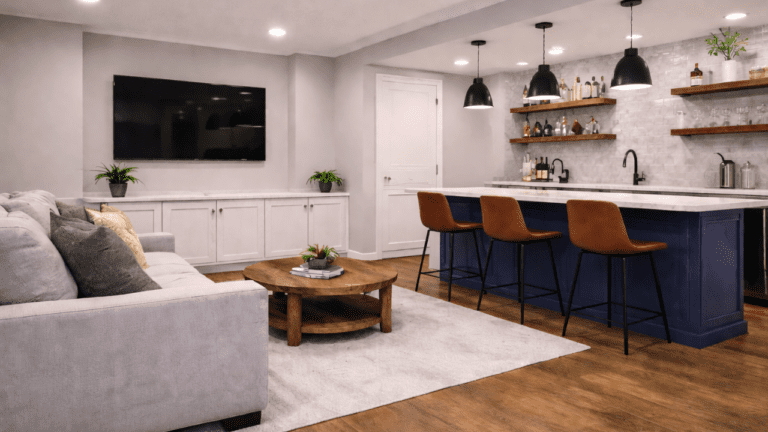
Path 2 — Split the Marketing Narrative From the Appraisal Narrative. Your marketing photos, floor plan, and MLS description can and should show the finished space and describe it accurately (“~600 sf finished lower level with media room, guest bedroom, and full bath”). What you cannot do is include it in the main square footage number on the MLS if it fails the ANSI test—that creates a disclosure and misrepresentation exposure under California Civil Code §1102, and it invites an appraisal challenge that will still lose. Best-practice East Bay listing convention in 2026: state above-grade square footage as the headline number, state below-grade finished square footage on a separate line, and photograph the space beautifully. Buyers pay for it emotionally even when the appraisal does not fully credit it.
Path 3—Price to the ANSI Number and Let the Finished Basement Be a Tie-Breaker. For most $1.5M–$3M East Bay sellers with 400–700 finished below-grade square feet, this is the winning path. Set the list price using above-grade square footage plus a below-grade contribution at roughly 60% of the above-grade rate. That price will appraise. In an active offer round, the finished basement becomes the reason a bidder pushes their offer $50,000–$120,000 over that anchored list — a premium the market pays but the appraiser cannot underwrite alone. Berkeley’s May 2026 6-offer median with 124% sale-to-list, and Oakland’s 3-offer median with 109–118% sale-to-list, both support this pattern: emotional value gets paid at the top of the offer round, not on the appraisal line.
Egress, Permits, and the East Bay Compliance Layer
ANSI is a measurement rule; egress is a life-safety and permit rule. Both matter to your sale, and they are frequently entangled.
If a below-grade room is marketed or disclosed as a bedroom, it must have code-compliant egress. Under the California Residential Code and IRC R310, a sleeping room requires an emergency escape and rescue opening: 5.7 square feet net clear opening, minimum 24 inches high, minimum 20 inches wide, and a maximum sill height of 44 inches above the finished floor. For a below-grade window, the exterior side needs a window well—at least 9 square feet in area with a minimum 36-inch horizontal projection. If the well is deeper than 44 inches, a permanent ladder or steps are required.
A below-grade “bedroom” that fails egress cannot be represented as a bedroom in the MLS, in the appraisal, or in the disclosure package. Doing so is a Civil Code §1102 exposure and a straight liability issue with the buyer’s insurance carrier. It also fails FHA and VA property standards outright, which matters if your likely buyer pool includes those loan types (mostly a factor at the lower end of Oakland below $1.2M rather than the core $1.5M+ Berkeley market).
Permits close-out matters too. Berkeley’s Permit Service Center and Oakland’s Accela portal both maintain the address history. If your basement conversion was pulled and finaled, that is a clean disclosure. If it was pulled and never finaled — an “open permit” — you have a discrete problem that will surface in the buyer’s due diligence and must be resolved or explicitly disclosed and priced. If it was never permitted at all, the treatment falls under the same disclosure and pricing logic as any unpermitted work: excluded from GLA, disclosed on the TDS and SPQ, priced at a discount, and often coupled with a buyer credit for retroactive permitting risk.
FAQ
Does the ANSI Rule Apply to Cash Buyers?
No — ANSI compliance is a lender-side requirement flowing through the Fannie Mae and Freddie Mac Selling Guides. A true cash buyer with no appraisal contingency is free to value the finished basement however they choose. In practice, roughly 15–25% of East Bay $1.5M+ closings are cash, and those buyers still use recent comps as their reference point—comps that were themselves appraised under ANSI. The effect leaks in either way.
What If My Basement Has 9-Foot Ceilings and Full Walkout Access?
Higher ceilings and true walkout access push the per-square-foot appraisal ratio toward the top of the 50–70% range, not out of it. The below-grade classification is binary under ANSI. If any perimeter grade is above the finished floor, the whole level is below-grade, and the appraisal reports it separately. Quality and light drive the ratio inside that band.
Can I Get an ANSI-Compliant Re-Measurement Before Listing?
Yes. Budget $400–$800 for a qualified appraiser to do a pre-listing ANSI measurement. In borderline cases — daylight walkouts, hillside additions, sloped lots where the grade dips at one corner — this is one of the highest-return $600 you will spend before a $2M+ listing, because it lets you build the pricing story, the MLS entry, and the disclosure package around a defensible number instead of guessing.
Does the ADU / AB 1033 Pathway Rescue My Finished Basement?
Only in narrow circumstances. AB 1033 lets you condo-convert an eligible ADU, but a below-grade converted space usually does not meet the ADU state standards for ceiling height, egress, and independent access. For most East Bay finished basements, the ADU path is not the answer — the answer is honest measurement, honest marketing, and pricing the space at what it is actually worth.
Does the Finished Basement Affect My Capital Gains Basis?
Yes. Documented capital improvements to the below-grade space add to your basis for the Section 121 exclusion calculation, whether or not those improvements are credited by the appraiser. Keep the receipts. See the 2026-05-06 capital gains post for the full basis mechanics.
What to Do This Week
The 2026 East Bay market is still moving fast enough that pricing precision matters more than list-side aggression. If you have a finished basement and you are within 90 days of listing, take three steps: pull the ANSI-compliant square footage number, close out any open permits at Berkeley’s PSC or Oakland’s Accela portal, and price the below-grade contribution at 60% of the above-grade rate as your anchor. The buyer pool will still pay for the space emotionally in a competitive offer round — but only if the list price is one the appraisal can defend.
Want to know your specific number? I prepare a custom net sheet for every seller I work with — actual estimated proceeds based on East Bay market data, your home’s above- and below-grade finished area under the current ANSI standard, and current closing costs. No automated estimate, no generic Zestimate. Just real numbers.
About the Author
Robert Parker is the CEO and team lead of The Parker George Team at Compass, serving the East Bay luxury residential market in Berkeley, Oakland, Piedmont, and surrounding neighborhoods. He helps buyers and sellers navigate the $1M–$5M+ market with a data-driven approach grounded in over a decade of local experience. DRE# 01923837. Connect with Robert at parkergeorge.com.
Check out this article next