

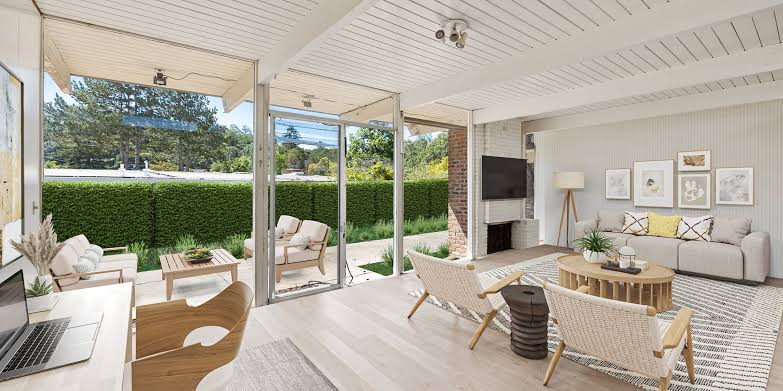
Virtually Staged Photos on Your Berkeley or Oakland Listing in 2026: What AB 723 and the Bay East MLS Rule Require Before You Go Live
Do you have to disclose virtually staged or AI-edited photos when you sell a home in California?
Yes. Since January 1, 2026, California Business and Professions Code section 10140.8—added by AB 723—requires a real estate broker or salesperson, or anyone acting on their behalf, to disclose any digitally altered image used to advertise a property for sale and to provide a link, URL, or QR code to the original unaltered image. On East Bay listings, Bay East and Contra Costa MLS Rules 11.5.1 and 11.5.2 go one step further: each altered photo has to be labeled inside the MLS, and the unaltered original has to appear in the same photo set. Routine edits—lighting, white balance, cropping, straightening, exposure—are exempt.
If your Berkeley or Oakland home is going on the market this fall and it is sitting empty, someone has probably already offered to virtually stage the photos. It is fast, it costs a fraction of real furniture, and the results look convincing on a phone screen.
It is also now regulated, and most of the marketing copy circulating about the rules is wrong.
Here is what actually changed, what it means for the way your listing goes live, and how I think about the staging decision on a vacant $1.5M–$3M East Bay house.
What AB 723 actually requires
AB 723 was signed on October 10, 2025, as Chapter 497, Statutes of 2025, and it took effect January 1, 2026. It added section 10140.8 to the Business and Professions Code.
The mechanics are narrow and specific:
- It covers "digitally altered" images—any image changed with photo-editing software or artificial intelligence to add, remove, or change elements of the property. The statute reaches fixtures, furniture, appliances, flooring, walls, paint color, hardscape, landscape, facade, floor plans, and elements outside of or visible from the property.
- It exempts ordinary photo work. Lighting, sharpening, white balance, color correction, angle, straightening, cropping, and exposure adjustments do not trigger disclosure, so long as they do not change how the real property is represented. A well-lit photo is still just a photo.
- It requires two things, not one. A reasonably conspicuous statement on or adjacent to the image saying it has been altered, and a link, URL, or QR code pointing to a publicly accessible page with the original, unaltered version.
- It applies to every channel, not only the MLS. Brokerage sites, syndication, social posts, print mailers, and brochures all fall inside "advertisement or other promotional material."
One point worth being precise about, because it changes who carries what: the statute regulates the broker and the salesperson, not you. I am the party on the hook for the disclosure and the link. What reaches you as the seller is the second-order risk—a buyer who removed contingencies partly on the strength of a photo that showed a room they never actually saw is a buyer with a misrepresentation argument, and you are the one who signed the disclosure package. That is why I treat photo decisions as part of the disclosure conversation rather than part of the marketing conversation—the same way I treat everything else that goes into California's full seller disclosure package.
The Bay East MLS rule that bites first
In practice, the statute is not what catches a listing. The MLS rule is.
East Bay listings run through Bay East and Contra Costa MLS, and both adopted Rules 11.5.1 and 11.5.2 effective January 1, 2026. Two obligations matter:
- Label the altered image inside the MLS. You label each photo using the MLS label function, with factual, descriptive wording—"Digitally Altered Image," "Virtually Staged," or "Digital Rendering."
- Pair it with the original. The unaltered version has to be displayed immediately before or after the altered image in the same photo set. Not on a separate page, not on request. In the sequence.
Rule 11.5.1 is the harder one. Adding, removing, or changing fixtures, furniture, appliances, flooring, landscape, views, or neighboring properties is treated as a violation, not merely something to label. There is a real line between furnishing an empty room and renovating it—repainting walls in a photo, swapping flooring, or editing out a neighbor's roofline is a different act from dropping in a sofa, and it is the second category that creates problems. Bay East has also signaled that it is looking at sky replacement as an altered-image question, which tells you how granular the interpretation is getting.
Now the part the vendor blogs keep getting wrong. You will see "AB 723 + $250 fine" in a lot of virtual-staging marketing. I could not verify that figure anywhere in the statute or in any MLS rule. CRMLS, which published the most detailed digitally-altered-images guidance in the state, said in its 2026 FAQ that there is no fine for violating the rule and that its Rules Committee would revisit fines during 2026. If you have been told the exposure here is a flat $250, that is not the exposure.
The real exposure is less tidy and larger: DRE discipline against the licensee, MLS compliance action and possible suspension of data access, and civil claims for misrepresentation or false advertising, which in California can carry damages and attorneys' fees. Nobody is writing a $250 ticket. Somebody is writing a demand letter.
Staging, virtual staging, or neither on an East Bay listing
A good share of the vacant homes I see in Berkeley, Oakland, and Kensington are trust or probate sales, or houses where the owner moved out first and listed second. Empty rooms photograph badly, so the staging question is real, and it is a money question.
Bay Area staging companies publish ranges in the neighborhood of $3,000 to $7,000 for a standard house, $7,000 to $15,000 or more for a larger or luxury property, with monthly continuation fees of roughly $500 to $1,500 once the initial period runs out, and consultations at $150 to $600. Those are published vendor ranges rather than numbers I can verify against closed transactions, so treat them as a starting point and get real quotes. Virtual staging runs dramatically less — one staging company quoted in national coverage this year charges $75 per photograph.
That gap is why the question comes up. Here is how I actually weigh it.
The honest case for virtual staging is a vacant room with good bones and bad proportions on camera—buyers genuinely struggle to judge scale in an empty space. Labeled clearly, paired with the original, and used to show furniture and nothing else, it does a legitimate job.
The case against it is what happens at the door. The chair of the International Association of Home Staging Professionals put it plainly: virtual photos may get a buyer in the door, but then "they don't see what they saw online, and it feels like false advertising." A Coldwell Banker Warburg agent quoted in the same reporting was blunter—"buyers actually resent it and respond very negatively when they feel they were deceived." CRMLS's general counsel calls the standard the industry is converging on the "true picture standard," and his buyer-side framing is the one I keep coming back to: "Putting up what [a listing] could be if you spent another $50,000, well, that's great for marketing. That's terrible for me as a buyer's agent."
In a market where East Bay buyers above $1.5M are often writing with contingencies already removed, resentment at the front door is not a soft cost. It is an offer you do not get.
You will also see the National Association of Realtors' 2025 Profile of Home Staging cited to justify staging spend—29% of sellers' agents reported staging produced a 1% to 10% increase in the dollar value offered. That report is a survey of agents' impressions, not transaction data: 1,266 usable responses from 49,806 invited Realtors, a 2.5% response rate, collected in February 2025. It tells you what agents believe. It does not establish what staging returns on a specific house, and I will not price your listing off it. Your specific number depends on your home's condition, your neighborhood's micro-market, and timing—that is where a real net sheet comes in, built from comparable East Bay sales rather than a national average.
There is a third option people forget: photograph the house honestly, empty, with good light and good composition, and put the budget into the things buyers cannot unsee. On most of the vacant East Bay listings I take, a thorough pre-listing inspection package and a clean, well-photographed house outperform furniture that is not there. For the detail underneath that, I have written separately on how professional photography and video actually affect sale price and on what staging actually moves the needle on in Berkeley and Oakland.
My practical rule, and what I tell every seller who asks me this:
- Stage physically if the house is empty, the budget is there, and the floor plan needs help.
- Virtually stage only furniture, never finishes—and label every frame, with the original next to it.
- Never alter walls, flooring, paint, views, or anything a buyer could walk in and find missing.
- If a vendor tells you disclosure is optional on your own website, get a different vendor.
FAQ
Does AB 723 apply to the seller or only to the agent?
Section 10140.8 regulates a real estate broker or salesperson, or a person acting on their behalf. As the seller, you are not the licensee the statute governs. Your exposure is indirect—a buyer who relied on an undisclosed altered image can bring a misrepresentation claim, and you are the party who signed the Transfer Disclosure Statement and Seller Property Questionnaire, so an inaccurate picture of the property can land back on you.
Is virtual staging still allowed on a Berkeley or Oakland listing?
Yes. Nothing in AB 723 or in the Bay East and Contra Costa MLS rules bans virtual staging. The rules require you to label it and to show the unaltered original alongside it in the same photo set. What those MLS rules do treat as a violation is altering the real property itself in a photo—flooring, walls, paint color, windows, views, or neighboring properties.
Do brightened or color-corrected photos need a disclosure?
No. The statute exempts lighting, sharpening, white balance, color correction, angle, straightening, cropping, and exposure adjustments, provided they do not change how the property is represented. The line is whether the edit changes what the property is, not how clearly you can see it. Turning on lights that were off, greening a brown lawn, or editing out cords and clutter goes past that line.
Is there a fine for getting this wrong?
Not a flat statutory fine, and the widely repeated "$250 fine" figure does not appear in the statute or in the MLS rules — CRMLS's 2026 guidance stated there was no fine for the digitally-altered-images rule and that fines would be revisited during 2026. The consequences that do exist are DRE discipline against the licensee, MLS compliance action including possible loss of MLS access, and civil misrepresentation or false-advertising claims.
What about photos of work I am going to finish before closing?
Treat that as a rendering, not a photo. Label it as a digital rendering, keep the current-condition original in the set, and put the scope and timing of the work in writing in the disclosure package. A buyer should never have to guess which version of the house they are buying.
The short version: virtual staging is still a legitimate tool on an East Bay listing, but as of 2026 it comes with a labeling obligation, a paired original, and a real liability tail if it is used to show a house that does not exist. Getting that right is part of the listing plan, not an afterthought at photo day.
Want to know your specific number? I prepare a custom net sheet for every seller I work with — actual estimated proceeds based on East Bay market data, your home's condition, and current closing costs. No automated estimate, no generic Zestimate. Just real numbers.
About Robert Parker
Robert Parker is the CEO and team lead of The Parker George Team at Compass, serving the East Bay luxury residential market in Berkeley, Oakland, Piedmont, and surrounding neighborhoods. He helps buyers and sellers navigate the $1M–$5M+ market with a data-driven approach grounded in over a decade of local experience. Connect with Robert at parkergeorge.com. DRE# 01923837.
Check out this article next