

Selling a Berkeley or Oakland Home With an Underground Oil Tank in 2026: The Heating Oil Exemption, the Alameda County Closure Permit, and the $3,000-to-$60,000 Decision Every Pre-1955 East Bay Seller Has to Make Before Listing
Quick answer for East Bay sellers with an underground oil tank
Do I have to remove an underground oil tank before I sell my Berkeley or Oakland home?
No—California does not require you to remove a residential heating oil tank before sale. A tank at a personal residence holding no more than 1,100 gallons of home heating oil for on-site consumption is exempt from California's Underground Storage Tank (UST) program under 23 CCR §2621 and State Water Board Local Guidance 109-1. But—and this is the piece most East Bay sellers miss—that exemption only covers the state UST program. It does not release you from your California Civil Code §1102 disclosure duty, from Alameda County or Berkeley closure-permit rules if you do decide to remove or abandon the tank, or from the reality that your buyer's lender and insurance carrier may still treat a known tank as a deal condition. The right question is not "do I have to remove it," but "which of four paths gives me the cleanest close at the best net price for this home, this micro-market, and this pre-listing timeline."
If you own a pre-1955 Berkeley or Oakland home—the kind of North Berkeley Craftsman, Elmwood shingle, Rockridge bungalow, or Adams Point four-square that anchors the Parker George Team's core micro-markets—there is a real chance an underground oil tank is sitting somewhere on your lot. The Alameda County Association of REALTORS' own Disclosures and Disclaimers Advisory puts it plainly: many of the larger, older homes in Alameda County built before 1935 may have or have had an underground storage tank for fuel oil, since oil-fired furnaces were the default before natural gas rolled out through Berkeley and Oakland in the 1930s and 1940s.
Most of those tanks are long-forgotten. They were bypassed decades ago when the furnace converted to gas. The fill pipe was capped, the vent was cut off flush with a foundation wall, and the tank itself—usually 275, 550, or 1,000 gallons—sits quietly under the driveway, the side yard, the flowerbed, or the crawl space, still holding a residual sludge of old fuel oil and rust.
None of that is a problem until you list.
At which point it becomes a real problem in three ways at once. First, your disclosure obligation. Second, your buyer's lender and insurance carrier. Third, the cost and timeline of doing something about it before the deal closes. This post walks through what the law actually requires, what the numbers look like in 2026 East Bay dollars, and how to decide between removal, abandonment-in-place, and price-and-disclose—before you list, not during escrow.
The California heating oil tank exemption—what it actually covers
If you read the state Water Board's Local Guidance document 109-1 or the underlying regulation at 23 CCR §2621, here's what the exemption says: a "heating oil tank" is a tank located at a personal residence that holds no more than 1,100 gallons of home heating oil used consumptively on the premises. Installation, operating, and closure requirements of the state UST program do not apply to these tanks. That is the entire exemption.
Read carefully what that exemption does not touch:
Your disclosure duty. California Civil Code §1102 requires you to complete the Transfer Disclosure Statement (TDS) for any 1–4 unit residential sale, and the TDS explicitly asks about environmental hazards, including fuel or chemical storage tanks and contaminated soil or water. The Seller Property Questionnaire (SPQ) that accompanies almost every East Bay transaction asks the same question in more detail. The disclosure standard is actual knowledge—if you know about the tank, or if you should have known (because you saw the fill pipe, or the pre-listing inspector flagged it, or the neighbor mentioned it), you must disclose. Civil Code §1102.1 makes third-party inspection findings non-waivable in as-is sales—which means you cannot disclose your way around a general inspector's tank observation with a blanket as-is clause.
Local permits. The California heating oil exemption is state-level. It does not preempt local rules. In Berkeley, the Toxics Management Division at (510) 981-7460 handles permits for the removal, installation, or modification of underground storage tanks—including residential heating oil tanks. In Oakland and most of unincorporated Alameda County, the Alameda County Department of Environmental Health (ACDEH) at (510) 567-6700 oversees investigation and cleanup when a release is suspected and works with the San Francisco Bay Regional Water Quality Control Board on Berkeley cases with concurrence. In Contra Costa County—El Cerrito and Kensington—Contra Costa Health Services Hazardous Materials Programs is the analog authority. A closure permit, a licensed contractor, and post-removal soil sampling are typical local requirements whether the tank comes out or gets filled in place.
Your buyer's lender. Fannie Mae's Selling Guide treats documented tank leaks and soil or groundwater contamination as unacceptable environmental hazards. FHA's Handbook 4000.1 and VA's Minimum Property Requirements both push appraisers and underwriters toward flagging unresolved environmental conditions. Even on a jumbo portfolio loan—the standard product on any $2M+ Berkeley Hills or Rockridge sale—an underwriter reviewing a file with an active or unabandoned oil tank is going to ask for documentation before they release funds. A tank the seller believed was cleanly bypassed twenty years ago can become a two-week clear-to-close problem if there is no closure report in the file.
Your buyer's insurance. Every California HO-3 policy in 2026 gets underwritten against known environmental conditions. Post-October 15, 2026, when the FAIR Plan's 29.1% rate increase takes effect and non-renewal risk stays elevated across the East Bay hills, the last thing a buyer wants to explain to their carrier is that they just bought a home with an unresolved UST.
So the state exemption is real, and it matters—it means you are not going to be dragged into a full CUPA cleanup case for owning an old bypassed tank. But it does not simplify the sale. If anything, it creates the exact ambiguity that trips up sellers who read one article, decide the tank is "exempt," and try to close without addressing it.
How to know if you have a tank at all—the pre-listing sweep
Half of the sellers I work with in North Berkeley, Elmwood, Rockridge, Adams Point, and Berkeley Hills are not certain whether their home has a UST. The furnace was converted to gas before they bought the house. There is no fill pipe they can see. But the age of the home and the neighborhood pattern suggest a tank might be there.
The right pre-listing step is a $250 to $500 tank sweep. A trained inspector uses two technologies in combination:
Magnetometer. A field magnetometer detects buried ferromagnetic objects to a depth of about nine feet below grade. It reads the difference in magnetic field strength between two sensors and flags the metal signature of a 275- or 550-gallon steel tank. Fast, cheap, and it catches the vast majority of buried oil tanks in level East Bay lots.
Ground penetrating radar (GPR). GPR uses pulsed electromagnetic waves to build a subsurface image and picks up non-conductive materials—including plastic pipes and fiberglass tanks that a magnetometer misses. On complex lots (hillsides, retaining walls, decks over old service yards), GPR is the second pass that removes ambiguity.
A pre-listing sweep is not a home inspection. It is a targeted environmental scan, and it produces a one-page report saying "no anomaly detected" or "anomaly detected at [location], depth [X]." That report—one way or the other—belongs in your disclosure package. If the sweep is clean, you have documentary proof for the buyer, the lender, and the appraiser that no tank is present. If the sweep flags something, you now know what you are dealing with before you list, and you can price the decision instead of react to it in escrow.
Every situation is different, and the only way to know for sure is to run the numbers with someone who knows this market block by block—but the pattern I see is that a $350 sweep on a pre-1935 Berkeley home is one of the highest-ROI dollars a seller can spend in the four weeks before listing.
The four paths when you find a tank
If the sweep confirms a tank—or if you already knew—you have four practical paths. Each has a different cost profile, timeline, and buyer-pool consequence.
Path 1 — Full removal before listing
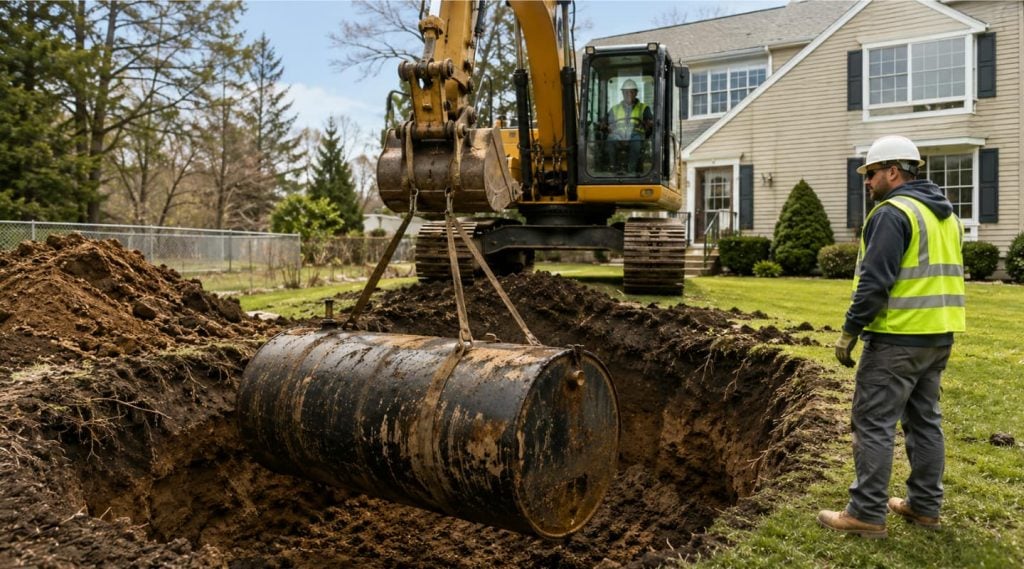
You hire a licensed tank contractor, pull the local permit through Berkeley's Toxics Management Division or the Alameda County/Contra Costa environmental health authority, excavate the tank, transport it as hazardous waste, and take confirmation soil samples from the tank pit walls and floor. If the samples come back clean, you receive a closure report — usually within four to eight weeks of removal — that you can hand to the buyer, the lender, and the appraiser.
Cost band for a clean removal on a typical Bay Area lot: $1,500 to $3,500 for the removal itself, $500 to $1,500 for confirmation soil sampling, and $1,000 to $2,000 for the local permit and administrative fees. Total budget on a clean case: roughly $3,000 to $7,000.
If the soil samples come back contaminated—which happens on tanks that leaked in service or corroded through over the last thirty years—the cost jumps to $8,000 to $60,000, sometimes more. Contamination extends the cleanup into an ACDEH-supervised remediation case, with quarterly reporting, groundwater monitoring wells in the worst cases, and a case number that follows the property until closure.
Best fit for Path 1: pre-1935 homes in $2M+ micro-markets (North Berkeley, Elmwood, Claremont, Berkeley Hills, Rockridge, and Lower Rockridge) where the buyer pool skews sophisticated and jumbo-financed, and where a "here is the closure report" line item at listing wins non-contingent offers.
Path 2 — Abandonment in place
If the tank is under a driveway, a garage slab, an addition, or in a location where excavation would require tearing up hardscape or structure, abandonment in place is the alternative. The contractor pumps out any remaining oil and sludge, cleans the tank, and fills it with an inert material — typically sand, foam, or a low-strength concrete slurry — so it cannot collapse as it corrodes. You pull a local closure permit for the abandonment (Berkeley TMD or Alameda County DEH) and receive documentation.
Cost band: $1,200 to $2,800 for the abandonment work, plus permit fees. If pre-abandonment sampling shows a release, you are back in the contamination-cleanup range.
The important part of Path 2 that most sellers miss: an abandoned-in-place tank still must be disclosed on every future sale of the property. It does not disappear from the property's history. The buyer will see it in your TDS, in your SPQ, in the closure documentation you hand over — and you will want that documentation to be complete and defensible, because the next time this home changes hands, the next seller will be relying on it.
Best fit for Path 2: tanks under structure or hardscape where removal cost would run $10,000+ due to demolition; tanks in tight urban lots where excavation logistics are impractical; sellers who want a fast pre-listing solution and are not chasing the last dollar of net.
Path 3 — Disclose and price
You know about the tank. You do not remediate before listing. You disclose it fully in the TDS and SPQ, you note whatever you know about its history, and you price the home to absorb a buyer credit or a discount.
Cost to you: whatever the market takes off the price. My working range in 2026 East Bay: $10,000 to $40,000 discount on a $1.5M–$2.5M home with an undocumented but disclosed UST, wider on $2.5M+ hillside homes because the buyer pool for a $3M home is smaller and less tolerant of "we don't know what's under the driveway." Days on market usually extends by 30% to 60% versus a comparable clean-history listing, and you lose 15% to 25% of the buyer pool outright — the FHA and VA financing tier walks, some risk-averse jumbo buyers walk, and cash buyers use the tank as a negotiating anchor.
Best fit for Path 3: heirs selling a family home who do not want to advance capital for remediation; sellers with severe pre-listing timeline pressure; homes at the top of a submarket where the discount is a smaller percentage of total value.
Path 4 — Sell to a cash buyer or flipper
At sale prices 25% to 40% below retail comp, cash buyers and flippers will take the tank off your hands and handle remediation as part of their scope. This is only rational math when the alternative — sitting on the market with a disclosed and unresolved tank — would cost more than the discount to a flipper.
Best fit for Path 4: contamination cases where the confirmation samples came back hot; long-vacant heir sales where the family cannot fund cleanup; sellers with a hard timeline (job relocation, health event, divorce close date) where certainty beats price.
A worked example — 1928 Elmwood Craftsman at $2.15M
Let's put numbers on this. Suppose you inherited a 1928 Elmwood Craftsman on Stuart Street. Three-bedroom, two-bath, 2,100 square feet, a raised foundation, a driveway that runs down the side to a detached garage. The pre-listing inspector notices a capped fill pipe near the driveway apron. Your comp set says the home lists at $2.15M and closes in the $2.25M–$2.35M range in this market — Berkeley's 2026 median has held around $1.5M, and Elmwood has been closing at 5 offers, 15 days on market, 109% to 124% of list on well-prepared homes.
You get a tank sweep for $350. Anomaly detected: a 550-gallon steel tank at 5 feet depth, roughly where the fill pipe suggests.
Path 1 — full removal before listing.
- Removal: $2,800
- Confirmation soil sampling: $1,000
- Berkeley TMD permit: ~$1,500
- Total budget: ~$5,300
- Soil comes back clean. Closure report in hand at listing.
- Sale price: $2.28M (right in comp band, non-contingent offer, 15-day close).
- Net after removal cost: $2.28M − $5,300 = $2,274,700.
Path 3 — disclose and price.
- No remediation cost upfront.
- Disclosed UST in TDS and SPQ, no closure report.
- Buyer pool shrinks about 15–20%. FHA and cautious jumbo buyers walk.
- Best offer comes in at $2.13M with a $30,000 tank credit at close.
- Sale price: $2.10M net ($2.13M − $30K credit).
- Days on market: 32 versus 15 for the clean listing.
- Sale price net: $2,100,000.
Delta between Path 1 and Path 3 on this specific home: ~$174,700, minus the $5,300 remediation investment. That is $169,400 of net proceeds preserved by handling the tank before listing rather than during escrow.
The math does not go the same direction on every home. A $1.4M Adams Point starter with a bad-luck contamination case that turns into a $40,000 ACDEH remediation project might be a Path 3 or Path 4 property. A $3.5M Berkeley Hills modern with an old tank under a poured driveway extension might be a Path 2 abandonment-in-place. The point is that the four paths are real, and the right one depends on your specific home, your specific micro-market, and your specific timeline.
Your specific number depends on your home's condition, your neighborhood's micro-market, and timing — that's where a real net sheet comes in.
Sequencing the decision — the four-week pre-listing playbook
If you are 4 to 8 weeks out from listing and you have an oil tank concern, here is the sequence that works:
Week 1. Pre-listing tank sweep. $250 to $500. Get the one-page report. If clean, put it in the disclosure package binder and move on with the rest of the pre-listing package (general inspection, Section 1 termite, sewer scope, roof report, chimney inspection, BESO for Berkeley homes, AB-38 fire hardening for hillside stock).
Week 1–2. If a tank is confirmed, get two written estimates — one for removal, one for abandonment in place. A licensed contractor with California Contractors State License Board classification and Alameda County or Berkeley environmental permitting experience is non-negotiable. Confirm scope: excavation, tank transport as hazardous waste, permit acquisition, and confirmation soil sampling.
Week 2–3. Pull the permit through Berkeley Toxics Management Division ((510) 981-7460 / [email protected]) if in Berkeley, or through Alameda County Department of Environmental Health ((510) 567-6700) for Oakland and unincorporated Alameda County, or Contra Costa Environmental Health for El Cerrito and Kensington. Berkeley TMD permit process starts at the Permit Service Center at (510) 981-7500.
Week 3–4. Removal or abandonment work. Typical one-day job on a clean access lot; two to three days if hardscape is involved.
Week 4–6. Confirmation soil sampling results and closure report issued. If the case escalates into contamination, this becomes a longer runway — you may need to postpone listing or run Path 3 with the ACDEH case number disclosed.
Week 5–6. Assemble the closure report, permit close-out, contractor invoices, and any soil sample results into the disclosure package. Discuss with your listing agent whether to include a one-page "environmental history" summary at the front of the package. On $2M+ non-contingent-offer markets like Berkeley and Rockridge, that one-page summary is often the difference between a jumbo buyer writing a clean offer and asking for a 21-day environmental contingency.
What triggers a full ACDEH investigation
Not every oil tank story ends in a big cleanup case. Most do not. The trigger for a Local Oversight Program case at Alameda County Department of Environmental Health is a confirmed release — soil or groundwater sample results showing petroleum hydrocarbons above regulatory thresholds. Once ACDEH opens a case, the property carries a case number and a state Water Board GeoTracker file, and the cleanup follows a defined path: site characterization, remediation plan, remediation execution, confirmation sampling, and case closure.
Closure cases typically run 12 to 36 months at costs of $15,000 to $150,000+ depending on plume size, groundwater depth, and remediation technology. In East Bay hillside terrain, the geology sometimes complicates things — Berkeley Hills fractured rock and Oakland's variable soil conditions can extend plume migration and drive costs higher than a flatland Adams Point or North Berkeley case.
This is why the pre-listing sweep matters. A tank that comes out clean under a controlled Path 1 removal is a $5,000 cost. The same tank that leaks slowly for another five years before the next owner discovers it during their own listing prep is a $50,000 cost — and it may be your cost, retroactively, if the disclosure trail from your sale is thin.
This is exactly the kind of question I walk my clients through before we even talk about listing.
FAQs
If I decommissioned the tank in the 1990s, do I still have to disclose it?
Yes. California Civil Code §1102 is an actual-knowledge standard, and knowledge that a tank was abandoned in place — even decades ago — is disclosable. The TDS asks about environmental hazards including fuel storage tanks; the SPQ asks about hazardous substances and known contamination. Disclose the abandonment, provide whatever documentation you have, and let your buyer's due diligence proceed on informed footing. Withholding the history to "keep the deal clean" is the fastest way to end up on the wrong side of a post-close disclosure lawsuit.
The neighbor's house had a tank. Does mine?
Not automatically. Oil-fired heating was common but not universal in pre-1955 East Bay stock. A tank sweep is the answer. If your home was built after roughly 1955 and you have no fill pipe visible, the odds of a UST are low but not zero — an outbuilding or a converted garage sometimes has one. A $350 sweep resolves the question in an hour.
What if my buyer's lender demands a Phase I environmental site assessment?
On residential single-family sales, a Phase I ESA is unusual but not unheard of on files that show a documented UST history. A Phase I is a $2,000 to $4,000 environmental engineer document that reviews historical records, adjacent land use, and physical site conditions. It does not require sampling; it just characterizes risk. If your lender or the buyer's lender requests one, expect a two- to four-week delay from order to delivery. This is a good reason to preemptively include your closure report and any historical documentation in the pre-listing disclosure package — a well-documented closure history usually removes the Phase I request before it happens.
Can I sell "as is" and skip all of this?
You can sell as is. What you cannot do is skip the disclosure duty. California Civil Code §1102.1 explicitly makes third-party inspection findings non-waivable in as-is sales, and the TDS obligation applies regardless of the as-is language in the contract. An as-is contract shifts the cost of repairs to the buyer; it does not shift the disclosure obligation to the buyer. Every experienced East Bay listing agent knows this, every plaintiff's attorney knows this, and every jury knows this.
How does this interact with Berkeley's Measure W transfer tax cliff on January 1, 2027?
The Measure W cliff — where Berkeley city transfer tax rewrites take effect and add $10,000 to $40,000 in tax for luxury sellers who close in 2027 instead of 2026 — creates real pressure on Berkeley pre-listing timelines this fall. If you have a suspected oil tank and you want to record before December 31, 2026, your practical deadline for pre-listing tank work is roughly mid-October to be safe. A four-week removal-and-closure timeline plus four to six weeks of pre-listing prep, listing, offer, and 35–45 day close means starting Path 1 or Path 2 in early October leaves comfortable runway. Starting in November means Path 3 or Path 4 becomes the realistic option.
Closing thought
The California heating oil exemption is one of the most misread regulatory carve-outs in East Bay real estate. Sellers read that residential heating oil tanks are exempt from state UST regulations, decide the tank is a non-issue, and then run into disclosure duty, local permits, lender scrutiny, and insurance underwriting the moment they list. The exemption is real — but it only protects you from being drawn into a state UST enforcement case for owning the tank. It does not simplify the sale.
The sellers who do best are the ones who spend $350 on a pre-listing sweep, decide with real numbers which of the four paths fits their home and their timeline, and put a clean environmental history in the disclosure package before the listing goes live. On a $2M+ Berkeley or Oakland home, the delta between handling this before listing and handling it in escrow is usually five figures of net proceeds — sometimes six.
If your home is pre-1955 and you are thinking about selling in the next twelve months, this is a question worth asking now, not in escrow.
Want to know your specific number?
I prepare a custom net sheet for every seller I work with — actual estimated proceeds based on East Bay market data, your home's condition, and current closing costs. No automated estimate, no generic Zestimate. Just real numbers.
About the author
Robert Parker is the CEO and team lead of The Parker George Team at Compass, serving the East Bay luxury residential market in Berkeley, Oakland, Piedmont, and surrounding neighborhoods. He helps buyers and sellers navigate the $1M–$5M+ market with a data-driven approach grounded in over a decade of local experience. DRE# 01923837. Connect with Robert at parkergeorge.com.
Check out this article next